Solution
Warehouse Management
ERPs repeat the lies we tell them. We capture the truth at the source instead.
Overview
Identity + Quantity + Context = Truth. Most systems collect only the first of the three, and collect it from a keyboard hours or days after the crate moved. Every reconciliation meeting is the cost of that gap.
The three come from the 5W2H framework: who, what, where, when, why, how and how much, asked of every movement. Read how we apply it to operations traceability, or fill in your own with the 5W2H requirements builder.
We close it by making the reading the source of the record. The crate is scanned and weighed where it is handled, the rules engine decides whether that reading is allowed, and only then does a document reach your ERP. The ERP you already run stays the system of record for finance and gains a unit-level ledger underneath it.
2,500+
Warehouses and factories live
100+
Cities
0.1%
Pilferage and wastage, down from 5%
2-3
New sites added every day
What people run on it
“Warehouse management” covers more ground than the four walls of a warehouse. These are the places it gets used, and what each one is really asking for.
| Warehouse and store inventory | Receive, put away, count and pick against your ERP. Handheld QR where scanning is fine, RFID zones where nobody has time to. |
|---|---|
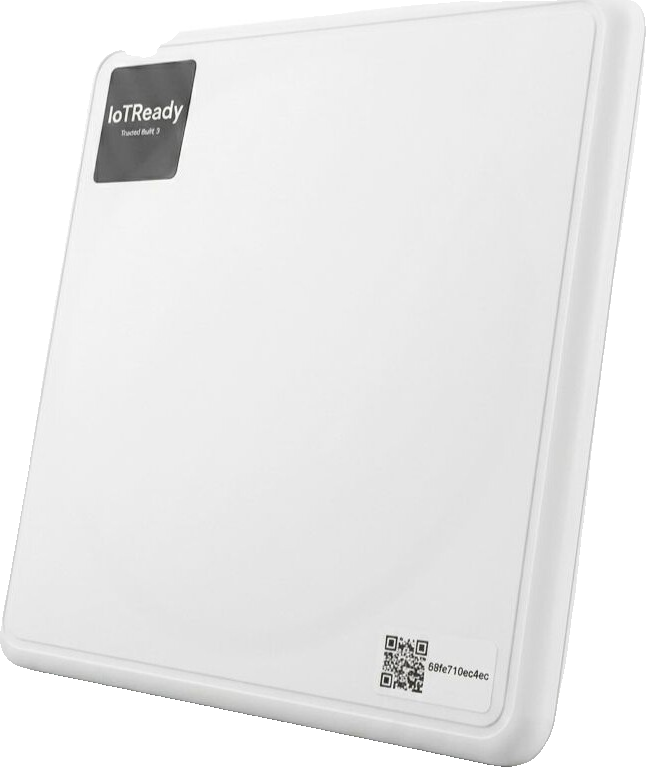
| RFID inventory | Fixed readers at dock doors and zones count stock as it moves. Cycle counts stop being a shutdown. |
| Yard and gate | Fixed RFID at the yard boundary reads material in and out without a person stopping to scan. This is how Vedanta tracks copper and aluminium from yard to plant. |
| Work in progress | Raw material to finished goods, with every stage between them logged. Surface WIP by age, and know which lot went into which batch. |
| Lab and consumables stores | Small, high-value, short-dated items - petri dishes at a pharma major - tracked per unit with expiry carried on the label. |
| Collection centres | Weighed and scanned at the point of purchase, offline, with the payout triggered off the same reading. |
Three layers
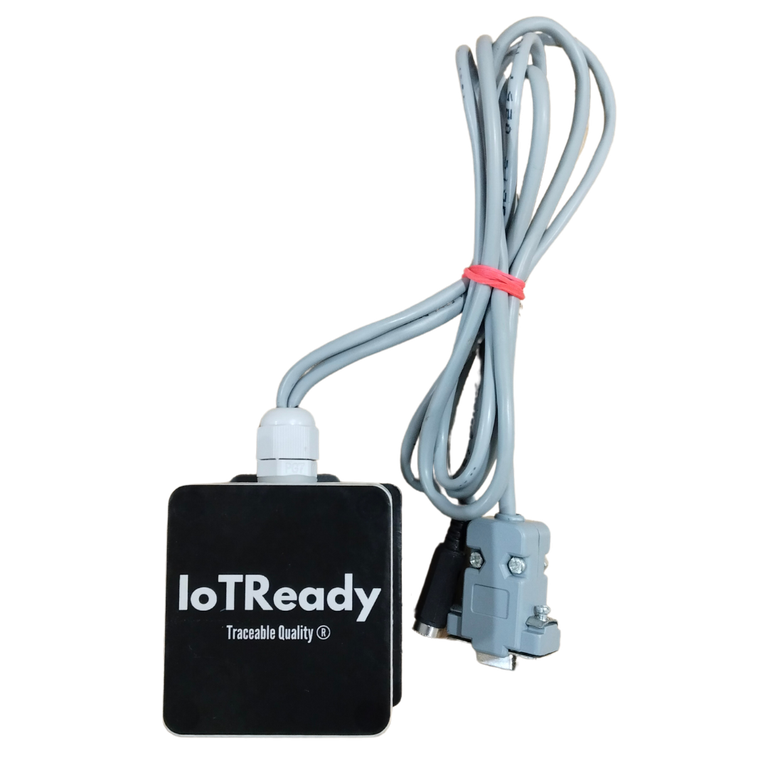
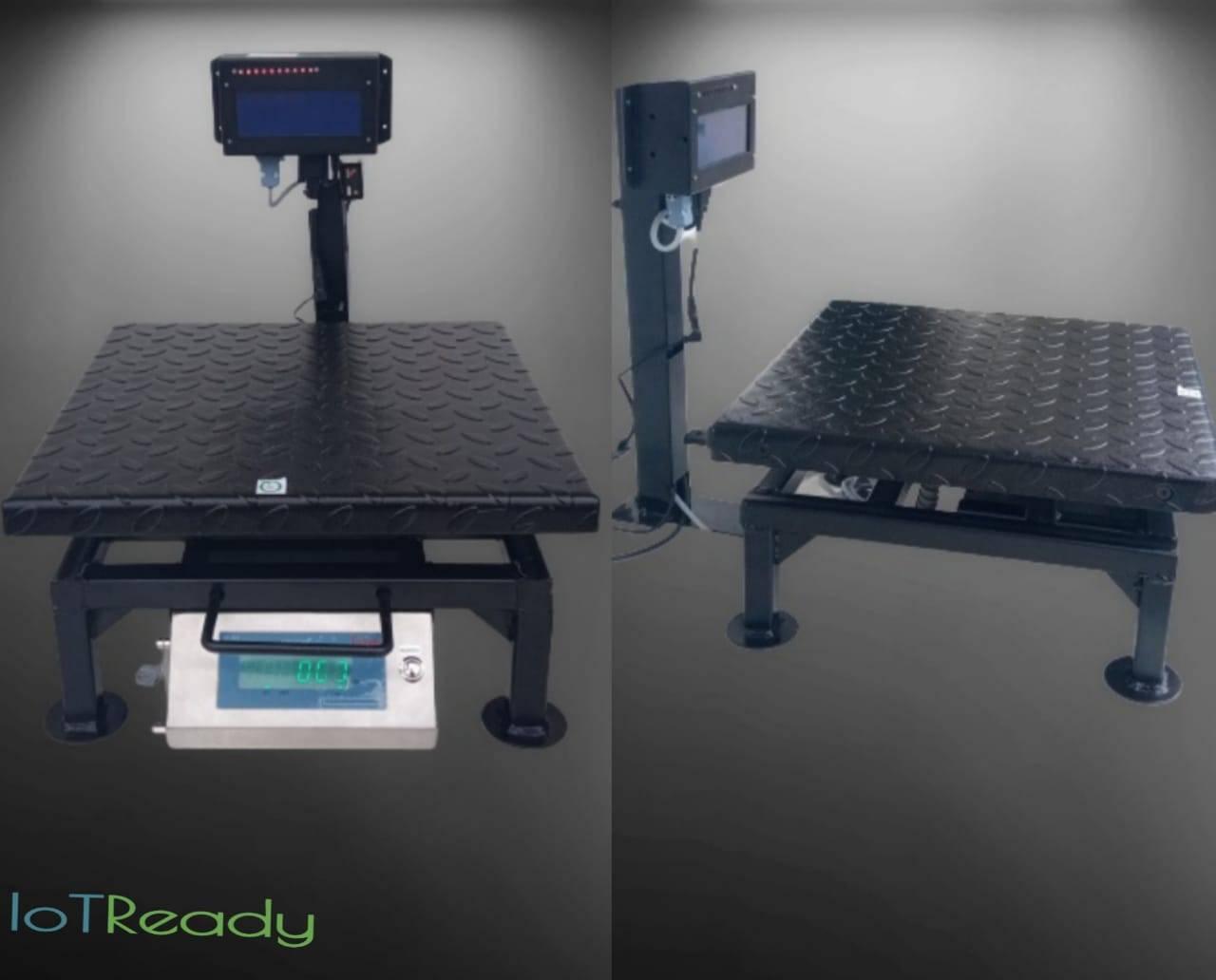
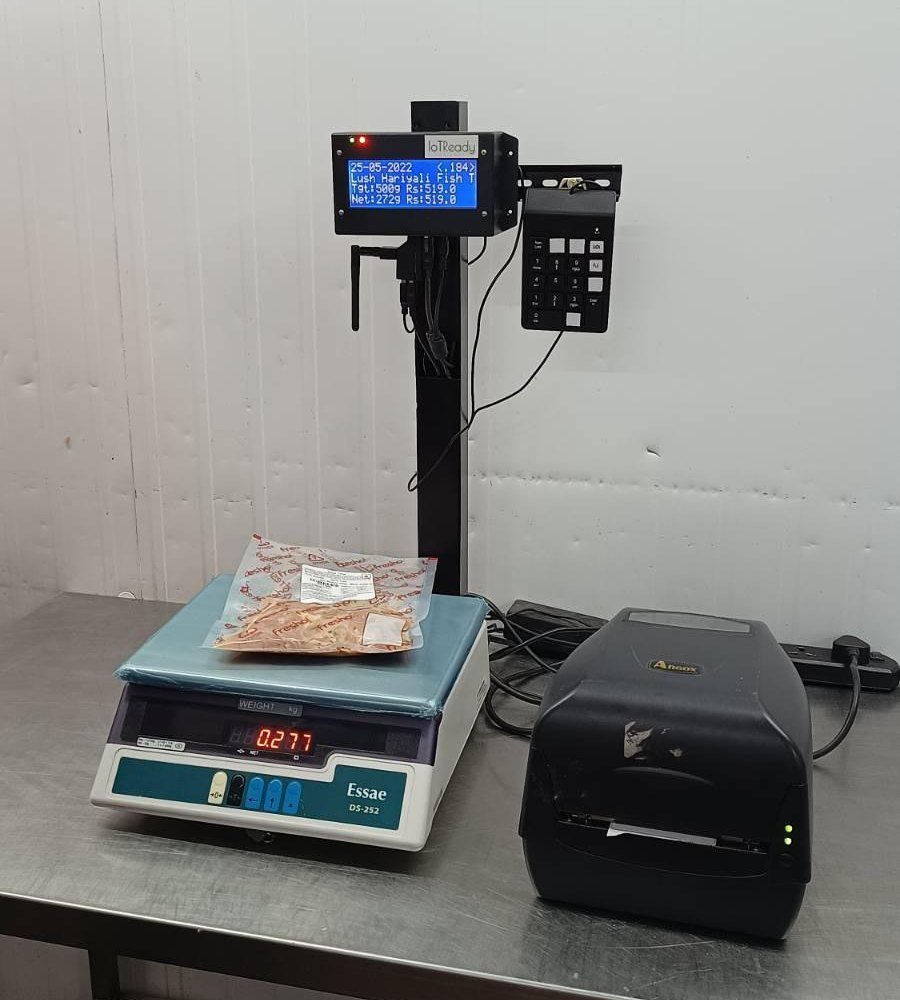
Hardware that assimilates into the workflow already running. The logger bolts onto the weighing scale on the floor rather than replacing it, and ships with an optional all-day battery because remote warehouses lose power.
A mobile app that is offline-first. A dead network at a village collection centre does not stop an operator. Activities queue on the device and sync the moment the connection returns, in the order they happened.
Cloud middleware built for unit-level traceability. Millions of events a day, thousands of simultaneous operators, and the discipline to batch those unit-level events into the documents your ERP already expects - a GRN grouped by supplier, warehouse and date - rather than flooding it with reads.
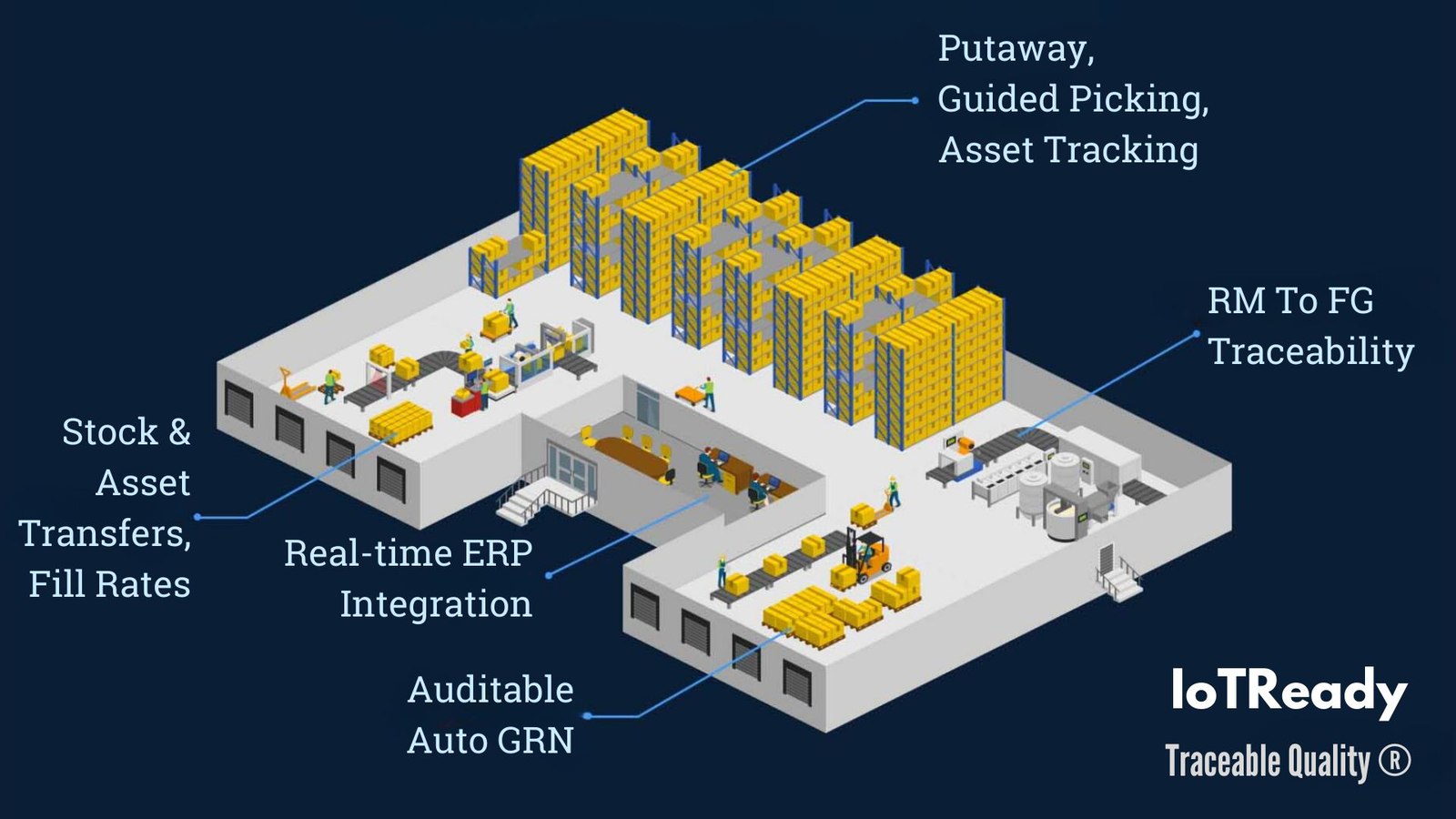
Every workflow is the same four beats
Procurement, transfer, split, count, label and pick are the same four beats repeated. Read the identity, capture the quantity, put both through a rule, and post the document if the rule passes. The operator finds out at the scale, while the crate is still in front of them.
The rules belong to you. Tolerances, FIFO policy, fill rates and over-pick allowances are configuration, and when the use case moves past configuration it is about twenty lines of Python on the dashboard. Or describe the rule in plain language to the Engineer, the AI built into Engine, and review what it proposes.
Nine workflows, one ledger
| Workflow | Read at the point of work | Validated before it posts | Document produced |
|---|---|---|---|
| Raw material procurement | Crate or pallet QR/RFID, plus weight | PO and quantity, against the supplier’s line | Auto-GRN |
| Finished goods procurement | Source crate, then the printed FG label | Fill rate against the RM consumed | FG receipt, ERP stock deduction |
| Put-away | Shelf QR, or the RFID zone itself | Zone correctness; unexpected movement | Bin allocation |
| Indent and transfer out | Destination, then each crate scanned | Destination and FIFO, with over/under-pick tolerance | Delivery challan, transfer note |
| Transfer in | Each crate scanned, weight optional | Source and indent; missing crates named | GRN, stock transfer completed |
| Crate splitting | Parent crate, then each child weighed | Quantity against the parent and the indent | Parent-child mapping retained |
| Cycle count | Handheld scan, or continuous RFID zone read | Expected against counted, moisture loss allowed for | Tamper-proof quantity adjustment |
| Packing and labelling | Source crate, then the scale | Overpacking, before the label is printed | Unique QR label, packed-inventory update |
| Customer picking | Sales order, then each label or crate | FIFO and sales order line, by count or by weight | Pick confirmation to your OMS |
Each one writes an auditable activity log carrying who, where and when. That log is what makes a downstream question answerable - which supplier’s lot went into that batch, who signed off the short-received pallet - without anyone reconstructing it from memory.
Receiving
Raw material procurement
Guided activity on the mobile app, at the dock or at a village collection centre.
- Unique IDs on the product itself, or on its carrier - crates, pallets, garment tags; RFID or QR, single-use or multi-use as the unit economics call for
- Optional weight capture on the data logger, with a display and LED array giving the operator a green light before they accept the crate
- Individual crate and pallet readings aggregated by supplier into SKU line items, then posted as an auto-GRN via API
- Scan-only procurement where the product arrives pre-labelled
Finished goods procurement
The moment a finished unit is created, bound to the raw material it came from.
- Link FG to RM through the activity itself or through pre-defined rules, so genealogy is captured as it happens
- Print a unique QR label per unit carrying SKU, batch number and date of manufacture - the same label is later used for put-away, picking and recall
- Post FG procurement to the ERP and deduct the consumed inventory in the same call
- Fill-rate validation blocks both the label print and the ERP submission on a mismatch
Put-away
Two options, chosen by what the site can justify.
- Auto put-away through RFID warehouse zoning, where the operator is guided to a zone and drops the goods off
- Guided put-away through a QR code on each shelf or rack - scan the shelf, scan the crate
- RFID zoning brings continuous asset monitoring with it, so theft raises a real-time alert
Processing
Indent and transfer out
Downstream warehouses raise material requests on the dashboard instead of by emailed spreadsheet.
- Assign a request to a picker, warehouse-driven or SKU-driven
- Configurable tolerances for over-picking and under-picking
- Auto-notify the receiving warehouse and auto-raise the stock transfer in your existing WMS
Transfer in
The audited counterpart to transfer out, reconciled crate by crate.
- Quantity transferred in compared against quantity transferred out, with real-time feedback to the receiving operator
- Auto-swap of equivalent crates, pallets or products belonging to the same SKU
- Bulk transfer-in by weight for statistical averaging, and mandatory representative sampling - 5% of crates, say - where the audit demands it
Crate splitting
Repackaging without losing the thread back to source.
- Child crates mapped to their parent, so traceability survives the split
- One-step split-and-transfer where the material is moving on immediately
- Quantity and indent validation on every child crate as well as the parent
Cycle count
Continuous stock verification instead of a quarterly shutdown.
- QR or RFID verification on a handheld; RFID zoning auto-counts through continuous monitoring
- Weight-based counting for SKUs with a weight UOM, with moisture loss auto-calculated for the geography and the weather
- Real-time alerts on unexpected stock level changes, and a tamper-proof trail of every quantity change
Dispatching
Packing and labelling
Centrally managed label templates, printed at the edge.
- Label templates, SKU information and price lists pushed from the central dashboard, so a price change is instant across every site
- Scan the source crate before printing, so the unique QR on the pack points back to the lot it came from
- Overpacking prevented at the scale, and packed inventory tracked in real time
- Labels from 1 to 6 inches, on USB and serial printers from Zebra, TVS, TSC and Argox - and designed to run inside a freezer
Customer picking
Pick lists created from the sales orders already in your OMS.
- Sales-order-driven or SKU-driven picking, assignable to a specific user
- Loose and weight-based SKUs confirmed by weight on the scale
- Auto-progress and quantity alerts built into the app, with rack and shelf identification
- Optional smart inventory trolley to assist the picker with verification and labelling
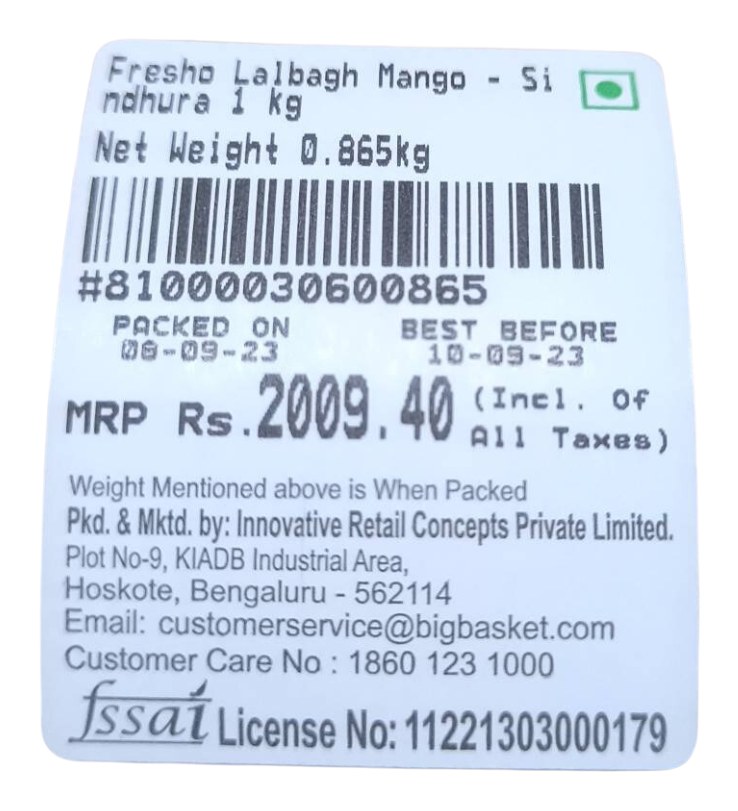
Built for the site
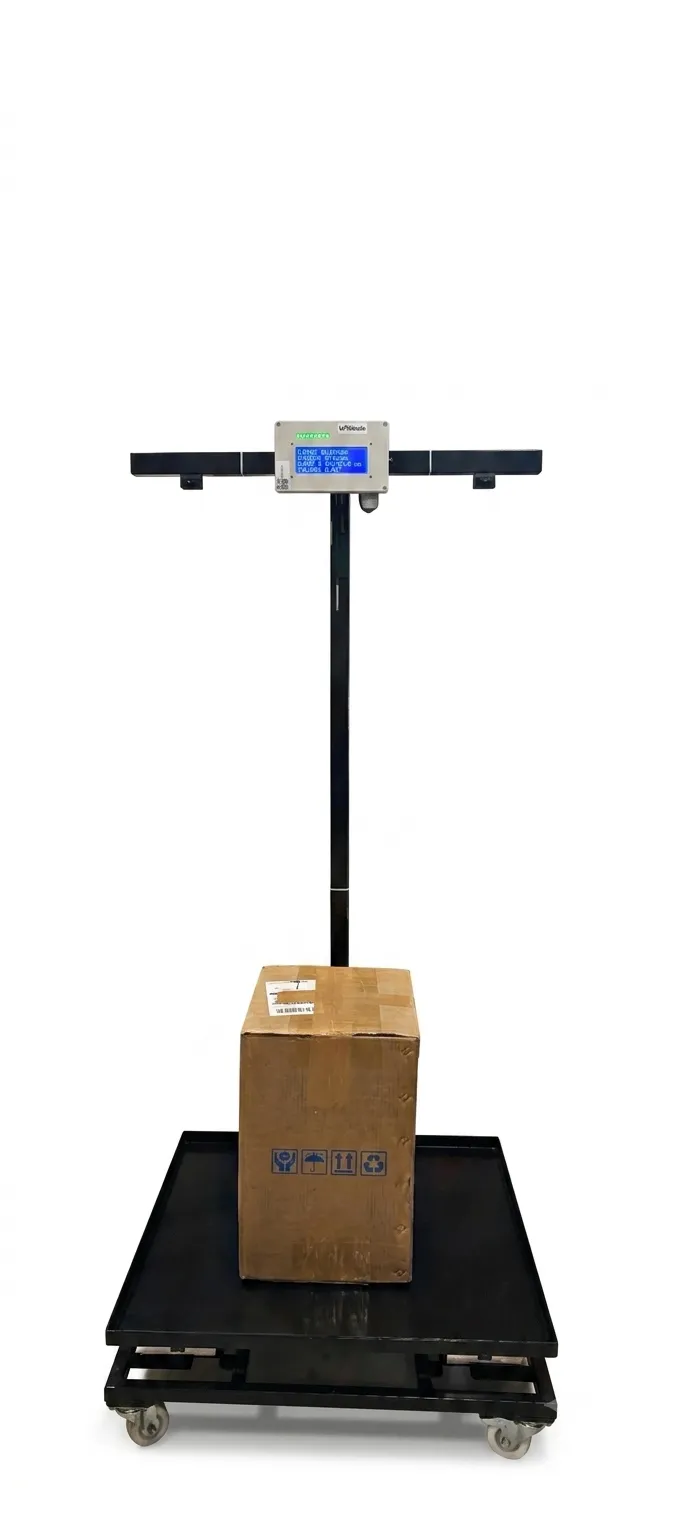
The hardware is designed for the warehouse it ships to. The logger integrates with any RS232 weighing scale from 100 g to 100 tonnes, on a stand customisable from 0.5 m to 1 m, with a barcode or RFID scanner built into the head so the crate ID and the weight are one motion rather than two. The app runs on any Android 7+ device, including the Zebra TC and Urovo DT handhelds your IT team has already bought.
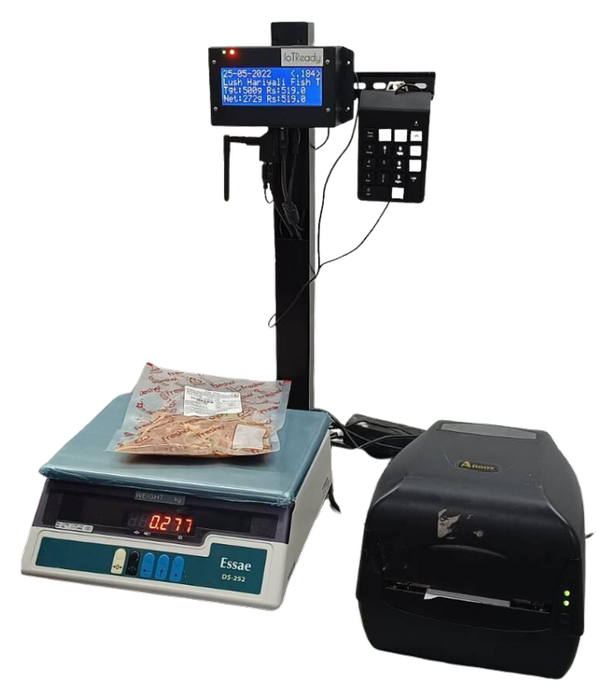
Retrofit onto your scale
The logger head bolts onto the RS232 scale already on the floor and drives the label printer directly.
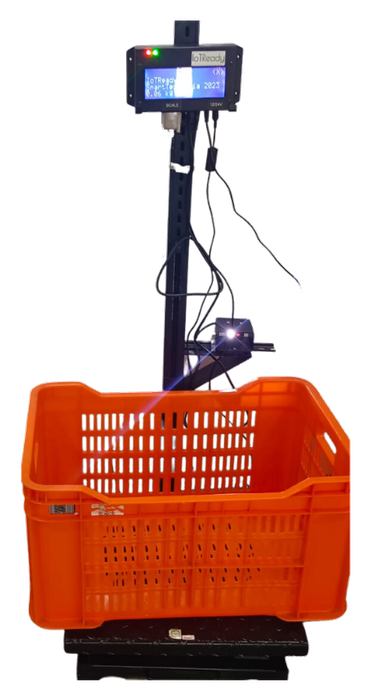
Weigh and scan together
One placement reads the crate ID and the weight in the same motion, no separate step.
| Weighing scales | Any RS232 serial scale, 100 g to 100 tonnes |
|---|---|
| Label printers | Zebra, TVS, TSC, Argox and others, USB or serial, 1" to 6" labels |
| Handhelds | Any Android 7+ device; Zebra TC and Urovo DT series supported out of the box |
| ERP and WMS | SAP, Zoho, ERPNext and others, over documented APIs |
| Authentication | SSO and LDAP, with data import and export |
| Power and network | Optional all-day battery; offline-first app with ordered sync |
In production
BigBasket runs sourcing, mid-mile and last-mile on IoTReady Engine. Crates are scanned and weighed at the collection centre; the operator gets a green light to accept; the GRN and the payout to the farmer are auto-triggered off the same reading.
Vedanta tracks the complete material flow from raw material to finished goods across stores and multiple facilities, with real-time visibility, a central dashboard for the CFO, sharply reduced PI/PV time, and automatic integration into their existing SAP.
GoDesi holds raw-material-to-finished-goods traceability across the whole production workflow, which is what lets them evidence FSSAI compliance for the inputs of any given batch - posted automatically into ERPNext.
What changes
Your ERP today
- Stock counted once a quarter, by hand
- Discrepancies discovered at audit
- A system integrator, six months to integrate, another two when the use case moves
- Reluctance to change a workflow, because changing it is a project
- Every number is a claim
With IoTReady
- Stock counted continuously, by the reader
- Discrepancies raised at the scale, the same shift
- Live before afternoon chai, because the workflows already exist
- Twenty lines of Python on the dashboard when the use case moves
- Every number carries its evidence
Raw material to finished goods, one dashboard, one ledger. It runs sourcing at a national grocer, copper and aluminium at a metals major, petri dishes at a pharma major, snacks, and cold chain, with different tags and tolerances in each.
Once the tags and readers are on site, asset tracking runs on the same infrastructure.
The model
Identity + Quantity + Context = Truth
Three inputs. Get all three at the moment of movement and the record needs no reconciling afterwards.
- Identity
- A QR, RFID or NFC mark on the crate, pallet, carton or SKU unit - single-use or multi-use, read off the item itself.
- Quantity
- Weight from the RS232 scale already bolted to your floor, from 100 g to 100 tonnes, with moisture-loss estimation for the geography and the season.
- Context
- Supplier, operator, site and time, carried by an offline-first mobile app and a business-rules engine that syncs to SAP, Zoho, ERPNext and others.
Where it runs
What captures it
Next step
Tell us what you are trying to trace.
Describe the flow: what arrives, what happens to it and what leaves. We will tell you what it takes to capture it.
or write to [email protected]